
9 Proven Tennis Drills 2025 You Can Master Alone at Home
Wondering how to practice tennis alone when your usual hitting partners are unavailable? Tennis improvement doesn’t require a court full of players or expensive training sessions. Fortunately, some of the most effective training happens when you’re completely on your own.
Finding consistent practice partners often becomes the biggest roadblock to improving your tennis game. However, the solitary nature of home practice offers unique advantages – specifically, the ability to focus intensely on technique without the pressure of rallying. In fact, many professional players regularly incorporate solo drills to refine their fundamentals and build muscle memory.
This guide provides nine proven tennis drills you can master at home without a partner or court. From shadow tennis for perfect stroke development to gamified target practice that sharpens accuracy, these exercises are designed to transform your living room, garage, or backyard into an effective training ground. Let’s explore these solo techniques that will elevate your game when you return to competitive play.
Shadow Tennis for Stroke Perfection
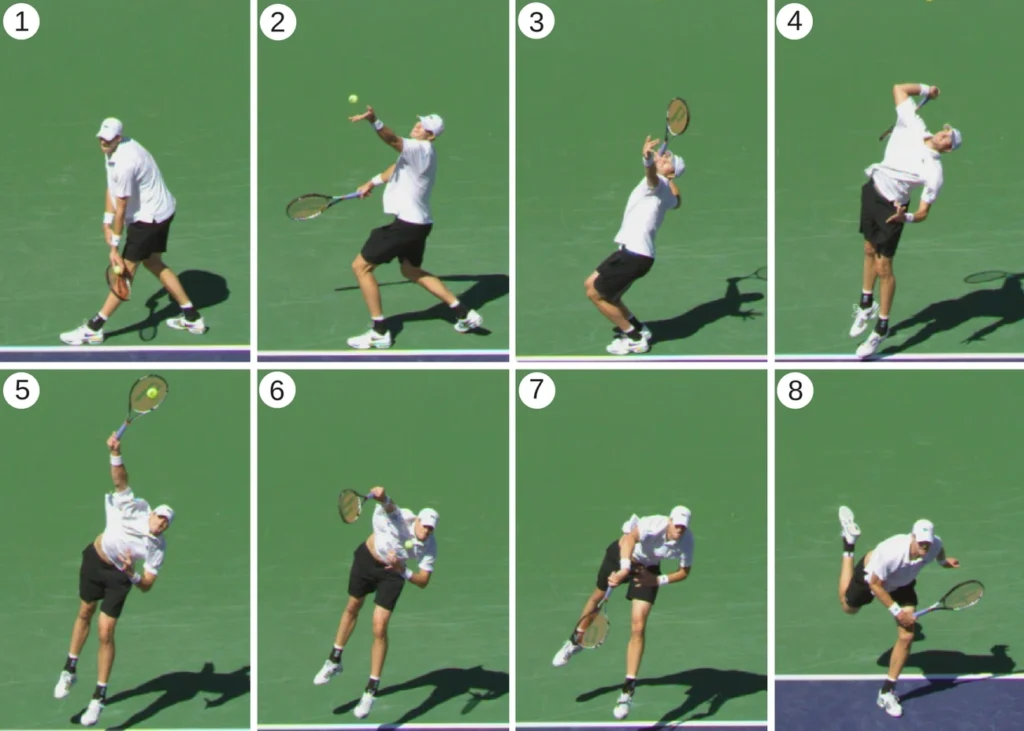
Shadow tennis stands as one of the oldest and most effective solo training exercises in a player’s arsenal. This technique involves simulating tennis strokes and movements without actually hitting a ball, allowing you to focus purely on form and technique.
What the drill is
Shadow tennis is more than just swinging a racket in the air. It’s a deliberate practice method where you execute complete tennis movements—from preparation to follow-through—without the distraction of tracking a ball. This versatile exercise challenges your speed, rhythm, and power while dramatically increasing your heart rate. Professional players regularly incorporate shadow tennis into their training routines, often practicing for up to an hour daily.
How to do the drill
To perform shadow tennis effectively:
- Find an open space where you can move freely
- Hold your racket as you normally would during play
- Move through various strokes (forehands, backhands, volleys, overheads) with proper footwork
- Focus on one or two specific “triggers” or technical elements rather than trying to perfect everything at once
For a structured workout, mix different strokes together for 1-2 minutes straight, then rest for 30 seconds. Complete 6-10 rounds with extended breaks between sets. Additionally, practicing in front of a mirror or recording yourself ensures correct technique development.
Why it works
Shadow tennis delivers remarkable benefits because it removes the variables that can interfere with technique development. Without a ball to chase, you can accumulate significantly more repetitions and focus entirely on movement quality.
The drill works by:
- Building muscle memory through high-volume, focused repetition
- Allowing you to identify and correct technical flaws without pressure
- Improving footwork patterns for different shot scenarios
- Developing natural rhythm in your stroke production
- Strengthening tennis-specific muscles
Moreover, shadow tennis helps players develop proper movement patterns for different situations—like approaching wide balls versus shorter ones—that become automatic in match play. The freestyle nature of this practice means you can work on virtually any aspect of your game anywhere, anytime—making it an invaluable tool for anyone looking to practice tennis alone.
Serve Toss Accuracy Drill
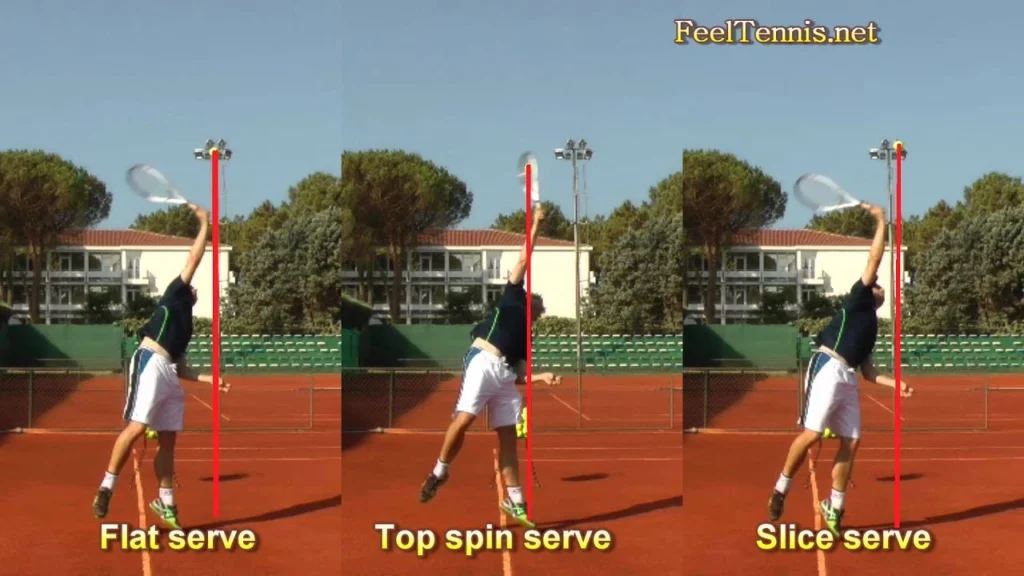
A perfect serve begins with a consistent toss, making it one of the most crucial yet overlooked elements of your tennis game. The serve toss accuracy drill focuses exclusively on this foundational skill, allowing you to transform your service motion without requiring a partner or court.
What the drill is
The serve toss accuracy drill is a targeted practice method designed to develop a consistent, reliable ball placement before striking your serve. Unlike the common misconception that serving is primarily about power, this drill emphasizes the precise positioning of the ball in your ideal strike zone. Professional coaches consider the toss so fundamental that an inconsistent placement not only makes the serve less reliable but also disrupts proper biomechanics and can potentially lead to injury.
How to do the drill
To practice this drill effectively:
- Find a room with a high ceiling and create a baseline using masking or duct tape
- Hold the ball with your fingertips, not in your palm, for better control
- Practice the “Keep Lifting” technique:
- Begin by lifting your tossing arm without releasing the ball to feel the motion
- Gradually add more height while maintaining the lifting feel, not throwing
- Imagine your hand as a magnet that continues influencing the ball’s path upward
- Aim for the ball to land approximately one foot in front of your front foot
- Release the ball from a position even with the top of your forehead
- For measurement, place a small pyramid of balls where your toss should land
Essentially, the goal is to consistently place the ball at the “1:00 position” (for right-handed players) directly off your front left toe.
Why it works
The effectiveness of this drill stems from its focus on creating stability in the vertical dimension of your toss. Studies analyzing professional players found they maintain remarkable consistency in the vertical axis, with standard deviation values lower than 5 cm. Furthermore, the players with the most accurate tosses, such as Roger Federer, create patterns barely larger than the tennis ball itself.
Consequently, a consistent toss:
- Allows your brain to build a reliable serve around a fixed point
- Creates proper torque and muscle stretching
- Enables you to release stored energy efficiently through the contact zone
Regular practice of this drill at home trains your arm to consistently place the ball in the same location, eliminating the frustration of “chasing” your toss during matches. Ultimately, this makes your serve more dependable under pressure, as you’ll no longer need to adjust your service motion to compensate for toss variations.
Wall Practice for Volleys and Groundstrokes
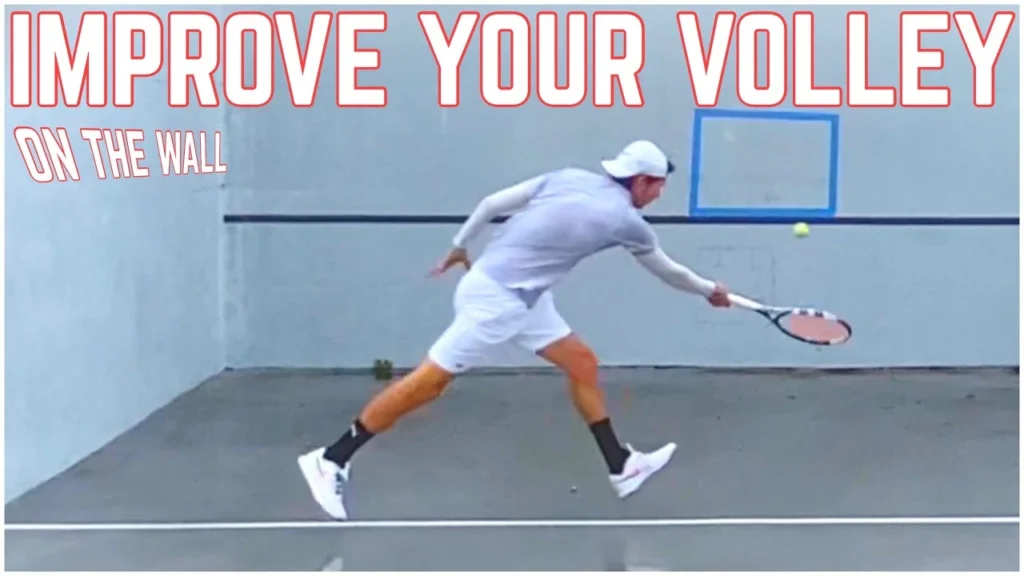
The tennis wall, often called a backboard, serves as a tireless training partner that never misses a shot. For those learning how to practice tennis alone, wall practice represents one of the most effective methods to sharpen volleys and groundstrokes simultaneously.
What the drill is
Wall practice involves hitting tennis balls against a flat vertical surface, creating an instant return that mimics rally situations. This versatile drill allows you to work on groundstrokes, volleys, half-volleys, and even overheads without requiring a partner. The wall becomes your consistent opponent, letting you focus entirely on technique and shot development rather than chasing errant balls.
How to do the drill
For groundstrokes:
- Begin with medium pace (about 75% of full power), focusing on control rather than power
- Practice specific sequences like three forehands followed by one backhand
- Alternate between deep and short balls to develop depth control
- Try moving laterally along the wall, hitting with both open and closed stance
For volleys:
- Stand closer to the wall to improve reflexes and forearm strength
- Keep your racket head above your wrist and non-dominant arm extended forward
- Start with single shot volleys, gradually mixing forehand and backhand
For transition practice:
- Hit several groundstrokes, then move forward for half-volleys and finally volleys
- Practice split-stepping as you approach the net
Why it works
Wall practice excels at building muscle memory through consistent repetition. Since the wall returns every shot, you develop greater consistency and ball control without interruption. Furthermore, the rapid-fire nature of wall practice improves your footwork, reflexes, and stamina simultaneously. Primarily, wall practice allows you to create your own training schedule, perfecting shots independently that would otherwise require a cooperative partner.
Ladder Footwork Agility Drill
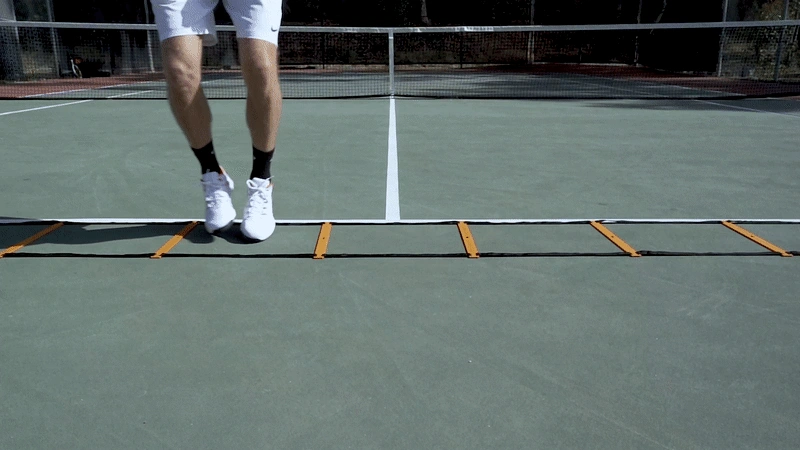
Agility and quick changes of direction form the cornerstone of effective tennis movement. The ladder footwork drill stands out as one of the most efficient ways to practice tennis alone while developing the rapid, controlled movements essential for on-court success.
What the drill is
The ladder footwork agility drill utilizes a specialized ladder laid flat on the ground to enhance speed, coordination, and overall movement efficiency. If you don’t have an actual agility ladder, you can create one using chalk, tape, or even the tiles on your home floor. This versatile training tool challenges your body to move in different directions and planes of motion, particularly enhancing lateral movement and reaction time.
How to do the drill
Initially, set up your ladder on a flat surface, ensuring it’s securely positioned. Start with these basic patterns:
- In-and-Out Steps: Step both feet into the first box, then quickly step one foot out on each side. Progress through the ladder maintaining balance.
- Lateral Movements: Practice quick side-to-side movements by stepping in and out of the ladder squares.
- Single-Foot Work: Touch each box with your inside foot while your outside foot maintains pace alongside the ladder.
Focus on quick, light steps with a consistent rhythm. Begin slowly to master the movements, thereafter gradually increase your speed without losing control.
Why it works
Ladder drills indeed develop the essential first step quickness that tennis players need after their split step. The continuous, fast-paced nature conditions your muscles to move rapidly, improving foot speed and leg turnover. These movements force your core and hip stabilizers to engage, enhancing balance during complex directional changes. For tennis players particularly, this training translates directly to better court coverage, as you’ll develop the ability to take small, controlled rapid steps rather than large forceful ones.
Racket Drop Technique for Better Serves
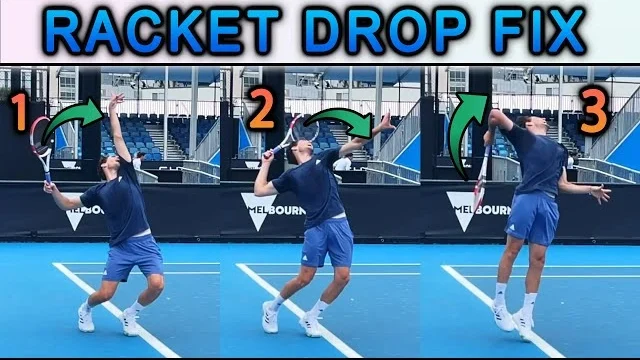
Developing proper racket drop mechanics transforms your serve power without requiring a partner. This often misunderstood technique represents a critical element of practicing tennis alone effectively.
What the drill is
The racket drop technique focuses on creating the optimal backswing position where your racket reaches its lowest point before accelerating upward to contact. Unlike common misconceptions, this movement shouldn’t be forced or manipulated—it’s a natural result of proper body mechanics and relaxation. The “Triple-Pat” drill teaches you to position the racket strings parallel to your back, creating the ideal drop position.
How to do the drill
- Start with a relaxed continental grip—never use a forehand grip as it severely limits your drop potential
- Practice the “Triple-Pat” exercise—pat your back three times with the racket strings facing your body
- Allow the racket to suspend from your fingers in an upside-down position, parallel to your back
- For deeper feeling, try holding the racket with just three fingers to prevent gripping too tightly
- Swing the racket in a circular path rather than a linear motion
Throughout practice, focus on keeping your grip loose—tension is the primary barrier to achieving proper racket drop depth.
Why it works
A proper racket drop naturally creates angular momentum rather than linear force. This circular motion generates significantly more power with less effort. Additionally, the relaxed technique prevents the pushing motion that causes inconsistency. Primarily, this drill develops the correct feeling of letting the racket “pull” you through the motion versus forcefully pushing it.
Mental Visualization and Match Simulation
Mind training represents an often overlooked yet powerful dimension of tennis improvement that requires no court, partner, or equipment. Mental visualization and match simulation drills train your brain to perform under pressure even when practicing alone.
What the drill is
Mental visualization (also called imagery) involves creating detailed mental pictures of tennis performances by engaging all senses—sight, sound, smell, feel, and taste. This technique includes both “mastery” visualization (perfect performance) and “coping” visualization (handling challenges like coming back from a lost set). Match simulation, meanwhile, recreates competitive pressure during practice by adding stakes or starting practice sets at specific scores.
How to do the drill
Firstly, create a brief script focusing on specific techniques or situations:
- Begin with 5-10 minutes daily of quiet, focused mental practice
- Engage all senses (what you see, feel, hear, smell on court)
- Record your visualization script with background music
- Practice both mastery (perfect strokes) and coping scenarios (bouncing back after mistakes)
- For match simulation, add consequences to practice (winner chooses next drill)
- Start practice sets with manufactured adversity (beginning down 0-3)
Why it works
Research shows muscle strength can increase up to 35% through visualization alone, without physical training. This occurs because imagining physical movements activates the same brain areas as actual movement. Your brain processes these visualized experiences as real, sending similar signals to muscles as during physical practice. Beyond technical improvement, this mental training develops resilience for handling pressure situations that frequently determine match outcomes.
Endurance Building with Zone 2 Cardio
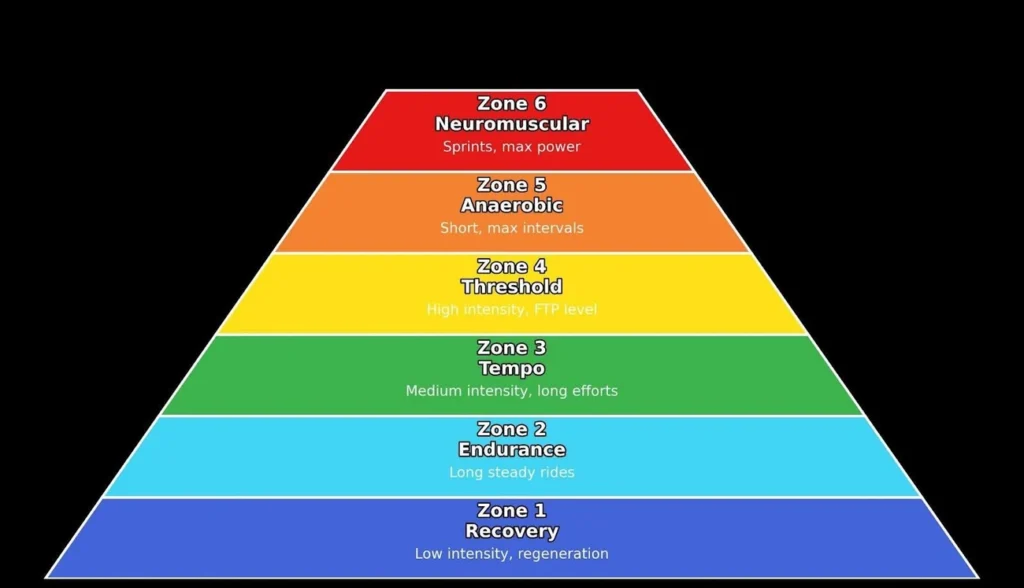
Cardiovascular endurance forms the foundation upon which all tennis skills are built, making Zone 2 cardio an essential element for solo improvement.
What the drill is
Zone 2 cardio refers to moderate-intensity aerobic exercise that elevates your heart rate to 60-70% of your maximum. This “Goldilocks zone” allows you to work hard enough to sweat lightly yet still maintain a conversation. For tennis players, this creates the metabolic state where your body burns the most fat for fuel. Elite tennis professionals recognize its value, dedicating 60-75% of their training time to Zone 2 work, often spending 80% of training at this intensity.
How to do the drill
To implement Zone 2 training effectively:
- Calculate your target heart rate: 220 minus your age, then multiply by 60%
- Choose tennis-specific activities: light jogging, cycling, or tennis-specific movement patterns
- Maintain 30-40 minutes at your target heart rate
- Perform 3-4 sessions weekly during off-season, reducing to 2 days for maintenance during competitive periods
The “conversation test” provides a simple check—you should feel you’re working but still able to speak in full sentences.
Why it works
Zone 2 training uniquely builds tennis endurance by improving mitochondrial density and function. Primarily, this enhances your body’s ability to utilize fat for energy, preserving glycogen for intense points. Although seemingly less intense than high-intensity interval training, Zone 2 work strengthens your heart to pump more blood per beat while creating more capillaries around muscles—crucial adaptations for lasting through long matches.
Gamified Target Practice at Home
Adding a playful element to home practice, target practice transforms routine tennis drills into engaging challenges through gamification. Turning technical practice into a game creates the competitive edge often missing when learning how to practice tennis alone.
What the drill is
Target practice involves setting up strategic objects as targets for your shots, plus adding scoring elements to create game-like scenarios. Beyond merely hitting balls, this drill creates a responsive practice environment that rewards precision and consistency. Much like video game mechanics, this approach establishes clear goals with immediate feedback on performance.
How to do the drill
To implement effective target practice:
- Set up various targets around your practice area
- Use household items like buckets, hats, or shoes as hitting targets
- Place cones at strategic locations mimicking court positions
- Draw chalk marks on walls or flat surfaces
- Create game-based challenges:
- Award points for successful target hits
- Track progress across sessions to “level up” in difficulty
- Gradually increase distance between you and targets for progression
Why it works
Target practice succeeds primarily by combining technical development with the reward systems found in games. Above all, this approach creates internal motivation through achievement-based progress. The drill enhances accuracy and precision that directly translates to better court strategies.
Furthermore, gamified practice triggers visualization skills as you imagine yourself as the protagonist overcoming challenges. Through this process, players develop stronger mental connections between technical skill development and match performance—creating a training environment that simultaneously builds both physical technique and strategic thinking.
Hand-Eye Coordination with Racket Bounces
Mastering the tennis ball-racket relationship forms a critical yet frequently overlooked component of solo tennis training. Hand-eye coordination exercises using simple racket bounces build the foundation for virtually every stroke in your tennis arsenal.
What the drill is
This drill involves bouncing a tennis ball repeatedly on your racket face in various patterns. Unlike structured stroke practice, racket bounces challenge your ability to judge ball trajectory, develop spatial awareness, and maintain control through continuous adjustments. The exercise ranges from basic up-and-down bounces to advanced maneuvers like alternating between racket face and frame, or incorporating spins and racket flips between bounces.
How to do the drill
Start with these progressions:
- Basic bounce: Simply bounce the ball continuously on your racket face while standing still
- Alternating surfaces: Bounce between the strings and frame
- Racket rotation: Flip your racket between bounces
- Movement challenges: Add walking, jogging, or specific footwork patterns while maintaining bounces
- Multi-ball drills: For advanced players, try the “pyramid bounce” using three balls – bounce one in the middle, bounce two others simultaneously, then catch them
For best results, practice 5-10 minutes daily, gradually increasing complexity as your skills improve.
Why it works
Hand-eye coordination represents up to 85% of brain activity during tennis movements. Therefore, these drills develop your brain’s visual processing capabilities through continuous feedback loops. Furthermore, racket bouncing familiarizes you with the weight and maneuverability of your racket while developing crucial touch and feel. Besides improving coordination, these exercises teach young players the relationship between racket face position and ball direction—knowledge that transfers directly to actual stroke production.
Conclusion
As you can see, practicing tennis alone offers countless opportunities to improve your game. These nine solo drills address every aspect of tennis development—from technical fundamentals through shadow tennis to mental preparation with visualization techniques. Though finding regular hitting partners remains challenging for many players, solo practice actually provides unique advantages that partner drills cannot match.
Remember that consistency stands as the key differentiator between recreational players and competitors. Five minutes of daily wall practice or shadow tennis yields greater improvement than occasional hour-long sessions. Additionally, combining these drills creates a comprehensive training program—perhaps shadow tennis for technique, followed by target practice for accuracy, then finishing with racket bounces for coordination.
Most importantly, these solo exercises build the muscle memory and neural pathways that translate directly to match situations. Professional players certainly dedicate significant training time to partner drills, but they also spend countless hours perfecting their skills alone. Their secret lies not in access to fancy facilities or equipment but rather their commitment to mastering fundamentals through deliberate solo practice.
The next time you find yourself without a hitting partner, turn that potential setback into an opportunity. Select one or two drills from this guide, commit to consistent practice, and track your progress. You might discover that some of your biggest breakthroughs happen not on the court with others but during those focused moments of solo training at home.
What solo tennis drill will you try first?