
Alcaraz vs Sinner 2025: Who’s Winning the Next-Gen Tennis Rivalry?
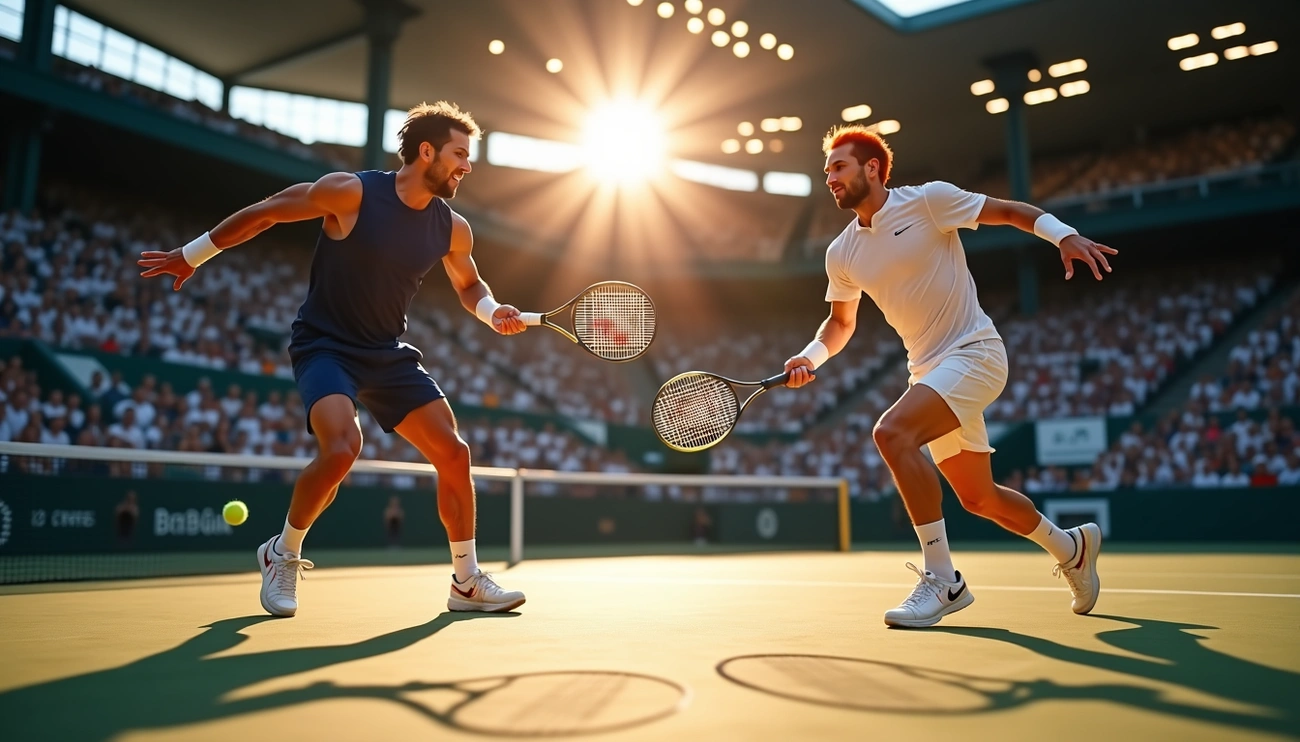
Carlos Alcaraz vs Jannik Sinner has quickly emerged as tennis’s most electrifying rivalry for the new generation. The two young stars have already produced breathtaking matches that rival the classic encounters of the Big Three era. Since their first professional meeting in 2021, they’ve battled across all three surfaces, with each contest revealing new dimensions to their evolving skillsets. Alcaraz’s explosive athleticism and creative shot-making contrast perfectly with Sinner’s clinical precision and relentless baseline power. Meanwhile, their head-to-head record continues to fluctuate, with momentum shifting dramatically through their Grand Slam encounters. From their five-set thriller at the 2022 US Open to their marathon French Open final in 2025, these two champions have consistently delivered tennis of the highest quality. But as their rivalry intensifies, a crucial question emerges: which of these phenomenal talents truly has the edge? Let’s analyze their fascinating history, statistical differences, and future prospects to determine who’s winning this defining next-gen rivalry.
Rivalry Origins and Early Encounters
The seeds of the Alcaraz-Sinner rivalry were planted long before they became household names in tennis. Their journey from obscure challenger events to center court battles traces a remarkable evolution that foreshadowed their future as the sport’s new standard-bearers.
Challenger Beginnings: 2019 Alicante
Before the packed stadiums and prime-time slots, Alcaraz and Sinner first crossed paths at the JC Ferrero Challenger Open in Alicante, Spain. In April 2019, a 15-year-old Alcaraz faced a 17-year-old Sinner in what would become the opening chapter of their storied rivalry. At that time, Sinner was ranked 319th while Alcaraz didn’t even hold an ATP ranking. In their inaugural encounter, the teenage Spaniard edged past Sinner 6-2, 3-6, 6-3 in one hour and fifty minutes, displaying the competitive spirit that would define their future matchups.
Notably, this match occurred in relative obscurity – the stands were nearly empty as these future champions battled, with spectators scarce enough to be countable. The tournament also featured former Top 10 player Tommy Robredo and Alejandro Davidovich Fokina, yet no one could have predicted how significant this particular first-round match would become in tennis history.
First ATP Match: 2021 Paris Masters
Following their challenger-level introduction, Alcaraz and Sinner met for their first ATP Tour-level match at the 2021 Paris Masters. At this point, their profiles had risen considerably – Alcaraz was 18 and ranked 35th in the world, while Sinner was 20. In a foreshadowing of their future battles, Alcaraz claimed victory in straight sets, 7-6(1), 7-5.
The match proved significant not only for their rivalry’s development, but also for Sinner’s ATP Finals hopes, as the loss bumped him down to ninth position when he had been hoping to make his first appearance at the year-end championship. After this encounter, Alcaraz prophetically remarked, “I think Jannik and I will have a great rivalry in the future” – words that would prove remarkably prescient.
Initial Momentum: 2022 Wimbledon and Umag
The rivalry gained substantial momentum in 2022 as they met three times, with Sinner taking the upper hand by winning two of those encounters. Their first Grand Slam meeting came at Wimbledon, where they made history as the youngest match by combined age at the All England Club since 1985. In their shared Center Court debut, Sinner defeated Alcaraz 6-1, 6-4, 6-7(8), 6-3 in an entertaining contest spanning three hours and thirty-five minutes.
Furthermore, the match featured dramatic shifts in momentum. Sinner controlled the early stages with his pure ballstriking, even holding two match points to close it out in straight sets before Alcaraz found his rhythm. After the match, Sinner graciously noted, “Carlos is a very tough opponent and a very nice person, so it is always a huge pleasure for me to play against him”.
Just weeks later, they faced off in their first final at the Croatia Open in Umag – additionally marking their first clay court meeting. Though Alcaraz took the first set, Sinner dominated the remainder of the match, winning 6-7(5), 6-1, 6-1. Remarkably, Sinner saved all nine break points against him, demonstrating the mental fortitude that would become his trademark. Alcaraz, the defending champion, struggled particularly on break points, going 0/9 in Umag after going 0/7 at Wimbledon.
As 2022 unfolded, these initial encounters established the foundation for what tennis fans and experts alike recognized was developing into one of the sport’s most captivating new rivalries – two young champions with contrasting styles yet equal determination, beginning what promised to be years of thrilling competition.
Major Finals and Turning Points (2022–2025)
Their rivalry truly exploded onto the world stage through a series of epic encounters that defined men’s tennis from 2022 to 2025. These matches not only showcased their extraordinary talents but also cemented their status as the sport’s new dominant force.
US Open 2022: The Five-Set Classic
The defining moment of their early rivalry arrived during a quarterfinal match that would become an instant classic. Their late-night battle in Arthur Ashe Stadium concluded at 2:50 a.m., setting the record for the latest-ever US Open match. This five-hour, fifteen-minute epic—the second-longest US Open match in history—saw Alcaraz prevail 6-3, 6-7(7), 6-7(0), 7-5, 6-3.
What made this encounter remarkable wasn’t just its duration but its quality. Alcaraz saved a match point in the fourth set, demonstrating the resilience that would become his trademark. The match featured an astonishing 18 breaks of serve in 54 games, with Alcaraz winning 45% of return points to Sinner’s 38%. Both players pushed their physical limits, with Alcaraz famously stating afterward, “I still don’t know how I did it”.
French Open 2025: Longest Final in History
Fast forward to June 2025, when they produced perhaps their greatest masterpiece. Their first Grand Slam final meeting became the longest French Open final in history at 5 hours and 29 minutes. Alcaraz’s comeback victory—4–6, 6–7, 6–4, 7–6, 7–6 (10-2)—featured extraordinary drama as he saved three match points when trailing 5-3, 0-40 in the fourth set.
This marathon contest became the second-longest men’s Grand Slam final ever, trailing only the 5-hour 53-minute 2012 Australian Open final between Djokovic and Nadal. In the first Roland Garros final decided by a fifth-set tiebreak, Alcaraz delivered his best tennis when it mattered most, hitting a stunning forehand passing shot on championship point.
Consequently, Alcaraz became the third-youngest man in history to reach five major titles, behind only Bjorn Borg and Rafael Nadal. The match statistics revealed remarkable balance—Sinner won 193 points, Alcaraz 192—illustrating how evenly matched these rivals had become.
Wimbledon 2025: Sinner Ends Alcaraz’s Streak
Exactly five weeks later, Sinner got his revenge. The Italian dethroned two-time defending champion Alcaraz with a 4-6, 6-4, 6-4, 6-4 victory, ending the Spaniard’s 20-match winning streak at Wimbledon. This three-hour triumph made Sinner the first Italian player to win a Wimbledon singles title.
Importantly, this match marked Alcaraz’s first defeat in a Grand Slam final, having previously gone 5-0. Sinner’s victory came through tactical brilliance—he won 30 of 40 net approaches while mixing in timely drop shots. The Italian displayed remarkable serving efficiency, holding 16 of 18 service games with just two double faults.
US Open 2025: Alcaraz Reclaims No. 1
Their rivalry reached another peak at the 2025 US Open, where they made history as the first men to meet in three consecutive Grand Slam finals in a single season. Alcaraz reclaimed both the championship and the world #1 ranking with a 6-2, 3-6, 6-1, 6-4 victory.
This relatively swift 2-hour 42-minute match showcased Alcaraz at his dominant best. He fired 10 aces without a single double fault and produced 42 winners compared to Sinner’s 21. The victory gave Alcaraz his sixth major title at just 22 years old and extended his head-to-head advantage to 10-5.
Throughout 2025, these two champions collectively dominated the sport, winning all four Grand Slams between them. Their remarkable consistency saw them reach eight major finals in succession, establishing a tennis duopoly reminiscent of the Federer-Nadal era. Indeed, they became the first men since Federer and Nadal (2006-2008) to meet in the same season’s French Open and Wimbledon finals.
Head-to-Head Breakdown by Surface and Tier
Beyond their spectacular Grand Slam finals, the Alcaraz-Sinner rivalry reveals fascinating patterns across different playing surfaces and tournament tiers. Their matchups have produced distinctive trends that highlight each player’s strengths and potential areas for growth.
Surface Stats: Hard (7–3), Clay (3–1), Grass (0–2)
A clear pattern emerges across the three surfaces. On hard courts, Alcaraz holds a commanding 7-3 advantage, despite Sinner being considered the premier hard court specialist of his generation. Remarkably, Sinner has achieved a near-perfect 94.6% win rate on hard courts during the 2025 calendar year, yet struggles against Alcaraz on this surface.
On clay, Alcaraz’s dominance becomes even more pronounced with a 3-1 head-to-head advantage. This aligns with his broader success on the surface, where he’s captured nine of his 18 tour-level titles, including Roland Garros and Masters 1000 events in Madrid and Monte-Carlo. Despite Sinner’s impressive 91.7% clay win rate in 2025, the surface clearly favors Alcaraz’s explosive movement and topspin.
Conversely, grass represents Sinner’s fortress. The Italian holds a perfect 2-0 record against Alcaraz on the lawns, including his statement victory in the 2025 Wimbledon final. This remains particularly interesting considering that Alcaraz has captured back-to-back Wimbledon titles in 2023 and 2024, yet cannot solve the Sinner puzzle on grass.
Grand Slam Record: Alcaraz Leads 4–2
The stakes rise dramatically at Grand Slam level, where Alcaraz maintains a 4-2 advantage over Sinner. Their six major encounters have produced some of tennis’s most memorable matches, especially their three consecutive Grand Slam finals in 2025.
Looking chronologically at their Grand Slam history:
- 2022 Wimbledon (R16): Sinner won in four sets
- 2022 US Open (QF): Alcaraz won in five sets
- 2024 French Open (SF): Alcaraz won in five sets
- 2025 French Open (F): Alcaraz won in five sets
- 2025 Wimbledon (F): Sinner won in four sets
- 2025 US Open (F): Alcaraz won in four sets
Evidently, Alcaraz has proven more clutch in the highest-pressure moments of their major encounters.
ATP Finals and Masters: Balanced Outcomes
In the prestigious ATP 1000 events, Alcaraz holds a commanding 5-1 advantage, demonstrating superior consistency at the Masters level. Nevertheless, Sinner has found success at the ATP Finals, winning his only encounter with Alcaraz in this year-end championship.
Across the remaining tournament tiers, the statistics reveal a balanced distribution of success: Alcaraz leads 1-1 in ATP 500 events, while Sinner holds a 1-0 advantage in ATP 250 tournaments.
Overall, their rivalry stands at 10-6 in Alcaraz’s favor, though this only tells part of the story. In spite of the lopsided overall score, their matches consistently feature razor-thin margins. Throughout their sixteen encounters, both players have demonstrated an extraordinary ability to adapt their games—Alcaraz finding new tactical approaches on hard and clay courts, while Sinner has mastered the art of grass court tennis against his Spanish rival.
Statistical Comparison of Playing Styles
Beyond their win-loss records, the numbers behind Alcaraz versus Sinner reveal fascinating differences in how each player approaches the game. Their contrasting statistical profiles highlight why their rivalry has become tennis’s most compelling matchup.
Aces and Double Faults: Sinner’s Edge in Clean Serving
Sinner demonstrates superior serving discipline, recording fewer double faults despite similar ace production. Throughout 2025, Sinner averaged 6.07 aces per match compared to Alcaraz’s 5.14. Moreover, Sinner’s double fault rate (1.25 per match) is remarkably lower than Alcaraz’s 2.47, giving him a substantial reliability advantage on crucial points. This pattern held even in high-pressure environments, with Sinner committing just 2 double faults versus Alcaraz’s 5 in their ATP Finals clash.
Break Point Conversion: Alcaraz’s Clutch Factor
Alcaraz clearly outperforms Sinner in crucial moments, specifically in break point scenarios. His break point conversion rate stands at 29.67% versus Sinner’s 21.56%, illustrating his ability to deliver under pressure. Accordingly, this clutch factor explains why Alcaraz has maintained his head-to-head advantage despite occasionally being outplayed in baseline exchanges. His break point conversion creates momentum shifts that repeatedly alter match trajectories.
Net Points and Aggression: Alcaraz vs Sinner
The most revealing difference in their playing styles emerges at the net. Alcaraz brings a “versatile artist” approach, blending “overwhelming power with the deft touch of a master craftsman”. In contrast, Sinner’s game revolves around “two of the most formidable groundstrokes in tennis”. This distinction becomes apparent in their net statistics—Alcaraz averages 9.66 net points won per match against Sinner’s 10.09, yet converts these opportunities at significantly different rates. During their 2025 US Open final, Alcaraz dominated with his forehand, hitting 14 drive winners to Sinner’s five.
Legacy and Future Outlook
After collectively winning eight consecutive Grand Slams, Alcaraz and Sinner have firmly established themselves as tennis’s dominant force. Their extraordinary rivalry has effectively ushered in a new era following the Big Three’s reign.
The ‘New Two’: Replacing the Big Three?
Just as tennis moved into uncharted territory after the Big Three’s dominance, the sport has returned to a familiar dynamic reminiscent of Federer-Nadal from 2005-2010. Currently, a substantial points gap exists between them and third-ranked Zverev, who sits closer to the 1,000th ranked player than to Sinner. According to Jim Courier, “This is now the era of the ‘New Two’… they’ve clearly shown that there’s separation there at the highest level”.
Who Has the Mental Edge in 5-Set Matches?
Regarding mental fortitude, Alcaraz holds a slight advantage. His ability to escape three match points at the French Open final—becoming only the third player in Open era history to win a men’s Grand Slam final after saving match points—showcased extraordinary resilience. Yet Sinner demonstrates remarkable capacity to learn from defeats, with his team noting: “All the losses I had, I tried to see the positive thing”.
Projected Dominance in 2026 and Beyond
Looking ahead, both could complete career Grand Slams by June 2026—Alcaraz needs the Australian Open while Sinner requires Roland Garros. Although no genuine third contender has emerged yet, potential challengers include João Fonseca, Ben Shelton, and Jack Draper. Former Spanish Davis Cup winner Feliciano Lopez believes their supremacy will continue: “The gap is too big because they are too good… and the difference is widening as time goes by”.
Conclusion
The Alcaraz-Sinner rivalry has undoubtedly established itself as tennis’s most electrifying next-generation battle. Throughout their sixteen professional encounters, these young champions have delivered matches of extraordinary quality, particularly their five-set epics at the 2022 US Open and 2025 French Open. Alcaraz currently leads their head-to-head 10-6, though this statistic fails to capture how evenly matched these competitors truly are.
Both players bring distinctive strengths to the court. Sinner demonstrates remarkable serving consistency with fewer double faults and clinical precision from the baseline. Alcaraz, meanwhile, excels during crucial moments, converting break points at substantially higher rates while showcasing his creative shot-making. Their contrasting approaches—Sinner’s metronomic power versus Alcaraz’s explosive athleticism—create the perfect stylistic clash that makes great tennis rivalries timeless.
Surface preferences reveal additional layers to their competition. Alcaraz dominates on hard courts (7-3) and clay (3-1), while Sinner holds the advantage on grass (2-0). This pattern suggests we can expect continued surface-specific battles as their careers progress.
Most compelling evidence points toward their complete takeover of men’s tennis. Their collective dominance—winning eight consecutive Grand Slams between them—mirrors the early Federer-Nadal dynamic that captivated fans worldwide. Tennis has officially entered the era of the “New Two,” with both players distancing themselves significantly from their nearest competitors.
Looking ahead, both champions stand poised to complete career Grand Slams by 2026, with Alcaraz needing the Australian Open while Sinner requires Roland Garros. Their rivalry will certainly continue shaping the sport’s landscape for years to come, much as the Big Three did for nearly two decades. The remarkable part? These two champions have barely scratched the surface of their potential.
Ultimately, the question of who’s winning this defining next-gen rivalry remains fluid. Alcaraz holds the statistical edge and demonstrates greater resilience in five-set matches. Nevertheless, Sinner continues evolving rapidly, learning from defeats and adapting his game accordingly. Tennis fans therefore find themselves in an enviable position—witnessing the birth of what promises to become one of the sport’s greatest rivalries, with many thrilling chapters still unwritten.